
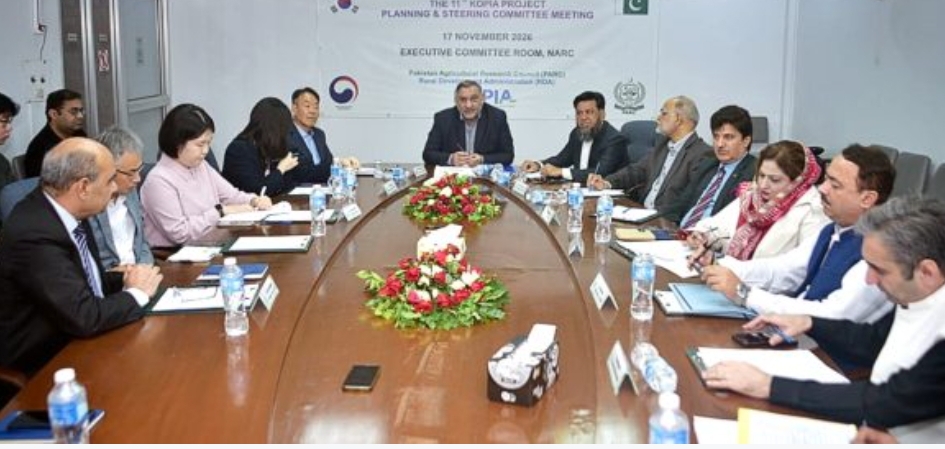
ISLAMABAD( WNAM REPORT): The Korea Partnership for Innovation of Agriculture (KOPIA) Pakistan Center, in collaboration with the Pakistan Agricultural Research Council (PARC), convened its 11th Project Planning and Steering Committee meeting at the National Agricultural Research Centre (NARC), Islamabad, to review progress under three Pakistan–Korea technical cooperation projects aimed at strengthening agricultural productivity, food security and farmers’ livelihoods.The meeting was chaired by Dr. Syed Murtaza Hassan Andrabi, Chairman PARC, with Park Intae, Director, KOPIA Pakistan Center, and representatives of relevant institutions and project teams. Chairman PARC emphasized that Pakistan–Korea collaboration is playing a vital role in introducing modern agricultural technologies, strengthening indigenous research capacity and improving productivity across key agricultural sectors. He reaffirmed PARC’s commitment to further strengthening this partnership to ensure effective technology transfer, sustainable agricultural development and tangible benefits for farmers across Pakistan.
The review covered ongoing initiatives in certified seed potato production, fodder crop development and cattle breed improvement, reflecting the growing scope of technical cooperation between Pakistan and the Republic of Korea.A major focus was the Pakistan–Korea Joint Programme on Certified Seed Potato Production, which is developing domestic capacity to produce high-quality, disease-free seed potatoes and reduce dependence on imported planting material.The committee was briefed on progress in establishing advanced seed production infrastructure, including aeroponic greenhouses, 36 screen houses, cold storage facilities, solar-powered systems and tissue culture capacity at NARC. The programme has produced approximately 1.47 million G0 seed potato mini-tubers since its commencement, while laboratory surveillance has covered 3,253 samples through more than 16,000 diagnostic tests. Training activities have also strengthened technical capacity among researchers, seed companies and farmers.The meeting also reviewed achievements under the fodder and forage development project, which promotes improved oat varieties, Italian ryegrass and village-based seed enterprises through farmer participation. The initiative has conducted 39 training events involving more than 1,500 participants and supported the expansion of improved fodder production practices across different agricultural regions of Pakistan.Progress under the livestock breed improvement project was also presented, focusing on the application of Korean Holstein genetics through artificial insemination services to support improvements in cattle breeding and dairy productivity.Together, the three initiatives demonstrate a practical model of bilateral cooperation that combines Korean agricultural technologies and technical expertise with Pakistan’s research institutions, local production systems and farming communities.The review provided an opportunity to assess implementation progress and consider priorities for strengthening technology transfer, institutional capacity and the wider adoption of improved agricultural practices.The partnership between PARC and Korea’s Rural Development Administration (RDA), implemented through the KOPIA Pakistan Center,continues to advance agricultural innovation and support the development of more productive, resilient and sustainable farming systems in Pakistan.
.